Between Power Cycles and Loss of Control
Tickets, Angels, and Access as a Political Statement
As always, the Congress takes place from December 27 to 30—and even access itself is a statement. Tickets are limited, and getting one feels like a lottery. Taking on Angel shifts improves your chances; after a certain number of volunteer hours, you receive a voucher for the presale. Those who cannot commit that time are left relying on networks and luck.
The Computer as an Actor of Surveillance
The talk “AI Agent, AI Spy” makes very clear what “agentic” AI means in everyday life. When operating systems and core applications continuously record, analyze, and correlate everything, the computer shifts from a neutral tool to an active observer. Even secure apps like Signal lose their protective effect when the OS constantly captures screenshots and contextual data. Microsoft’s Recall feature in Windows 11 serves as a cautionary example: a feature marketed as productivity-enhancing that, in practice, represents a permanent security and privacy risk.
Link: AI Agent, AI Spy – Udbhav Tiwari & Meredith Whittaker
“Neutrality” as a Weapon
The talk “Who Is Afraid of the Neutrality Requirement?” shows how legal concepts are being politically instrumentalized. The neutrality requirement applies to state institutions, but it is increasingly used to attack civil society organizations that take a stand against inhumane policies or right-wing extremism—with the aim of stripping them of legitimacy and public funding. At a time when authoritarian forces are gaining strength across Europe, “neutrality” is becoming a blunt weapon against democratic engagement.
Link: Wer hat Angst vor dem Neutralitätsgebot? – Hannah Vos & Vivian Kube
Data Rights with the Handbrake On
The talk “We, the EU, and 1064 Danes…” looks at major European data access laws such as the GDPR, DSA, and DMA. On paper, they are meant to create transparency and give users real control rights. In practice, researchers often end up with fragmented, incomplete, and barely usable datasets—such as YouTube histories. Nevertheless, the project involving 1,064 Danes shows that persistence and legal expertise can still yield valuable insights into platform mechanisms.
Link: We, the EU, and 1064 Danes… – David & LK Seiling
Digital Independence Day and a Different Internet
“The Kangaroo Rebellion: Digital Independence Day” combines humor and resistance. The idea: on the first Sunday of every month, volunteers help people find alternatives to the big platforms—from X to Mastodon, from Chrome to Firefox, from Amazon to the local bookstore—and then actually leave their old accounts behind. Opting out becomes a collective practice rather than a moral individual decision.
Links:
- Die Känguru-Rebellion: Digital Independence Day – Mark-Uwe Kling & Linus Neumann (#DIT)
- Initiative DI.DAY: digitalcourage
Cory Doctorow sharpens the argument in his talk “A post-American, enshittification-resistant internet.” The “enshittification” of the internet—the systematic degradation of platforms in favor of profit and control—is not a technical necessity but the result of political decisions, from trade wars to platform monopolies. Precisely these fractures, however, now open up room for federated systems, open protocols, and an internet that resists total commodification.
Link: A post-American, enshittification-resistant internet – Cory Doctorow
Assemblies: Where the Future Is Still Being Repaired
In the Assemblies, the counter-model to a broken digital world continues in hardware and practice. Discussions and hands-on work revolve around open-source security devices, experimental EMR projects, “make & repair” initiatives, and movements like End of 10—less consumption, more self-empowerment. Between soldering irons, Linux setups, and spontaneous lightning talks, a sense of community emerges that is almost entirely absent from everyday platform life.
Watch the Congress Yourself
39C3 is not an experience that should merely be retold when you can explore it yourself. All talks are freely available online—perfect for long winter evenings, team watch sessions, or a personal “Digital Independence” weekend.
Starting points:
Complete 39C3 media library Program overview with talks & lightning talks
Goetz’s final advice: pick a topic that is genuinely bothering you right now—surveillance, platform economics, democratic erosion—and start with exactly one talk. The Congress does not replace politics, but it helps to see the state of the world more clearly—and to realize that you are not alone.
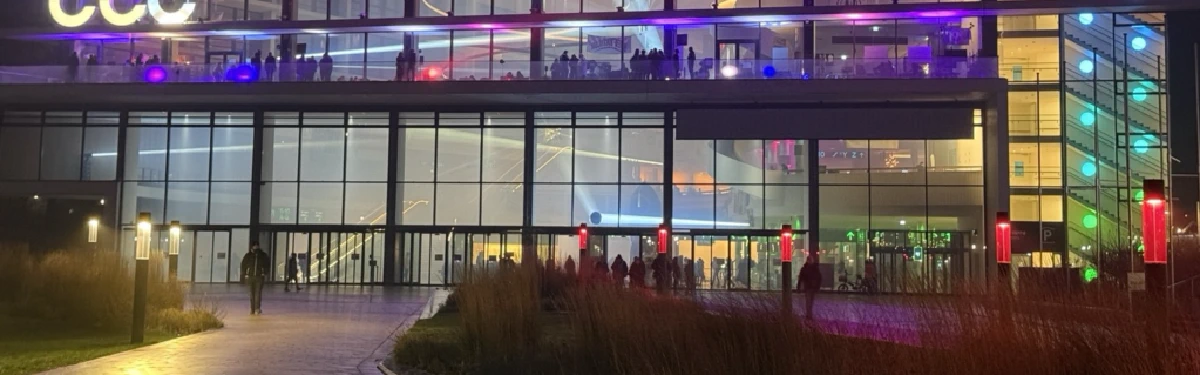
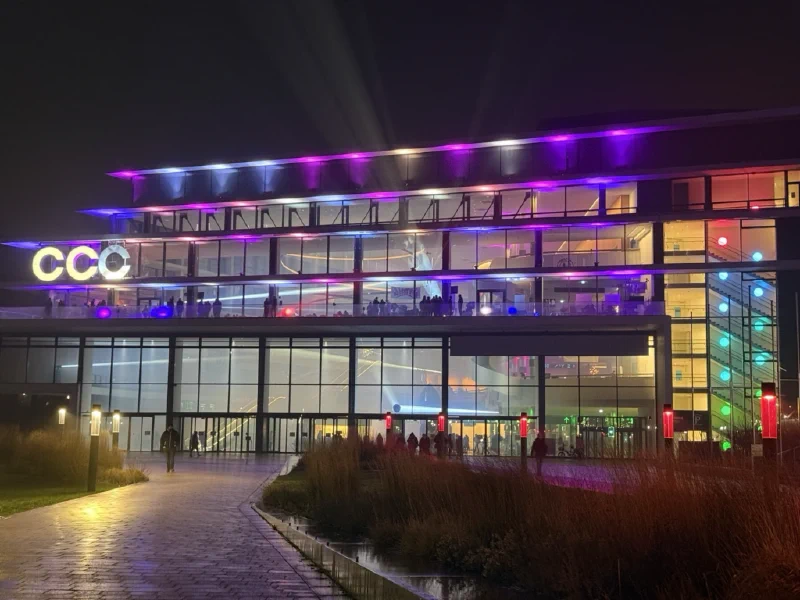
Caption: The Building by Starpeak